

- This event has passed.
#7 Masterclass on ‘Sensitization on Heat Action Planning and the Role of Nature-Based Solutions’
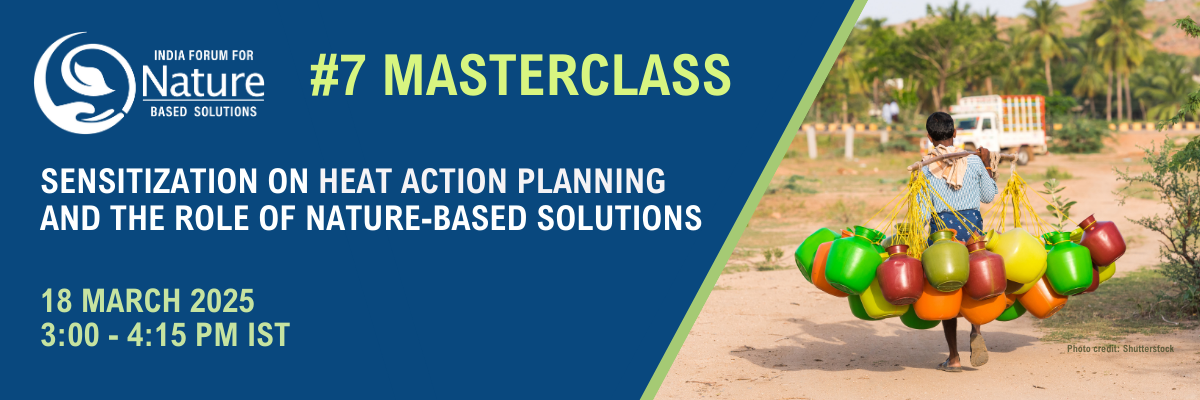
With rising global temperatures and increasing frequency of extreme heat events, India faces significant risks to human and ecosystem health, labor productivity, and livelihoods. Heat stress exacerbates vulnerabilities, especially among the marginalized communities and population groups such as outdoor workers, women, children and the elderly. Prolonged exposure to heat is also reducing workforce efficiency and effecting yields thereby disrupting key economic sectors such as agriculture, construction, and manufacturing industry.
The urgency to address heat-related challenges has led to the development of various plans and policies to strengthen heat resilience at national, state, and city levels including the Heat Action Plans (HAPs).To be effective, these plans must be designed at scale, integrating governance, data-driven risk assessments, and nature-based solutions (NbS). This masterclass will explore the need for heat action planning and how NbS can play a crucial role in urban resilience strategies.
Key Themes & Focus Areas:
<em”>Heat Action Planning & NbS
- Understanding large-scale impacts of heat by highlighting the impacts of exposure and urbanization/ changing land use patterns putting cities at greater risk
- Highlighting the national and sub-national measures needed for an integrated approach to heat governance
- Case study: Tamil Nadu Heat Mitigation Strategy, exploring how state-wide strategies can create systemic resilience to extreme heat
ULB level Heat Action Plans
- Importance of city-level heat action planning and governance frameworks
- Steps for mapping heat risks to identify hotspots and integrating NbS into city heat action plans and assessing their impact
- Case study: Thane Heat Action Plan, highlighting challenges and successes
This Masterclass is for:
- Government officials and policymakers responsible for designing and implementing Heat Action Plans at the state and city levels.
- Researchers, academicians and professionals contributing to data-driven risk assessments and policy frameworks for heat adaptation.
- NGOs, private sector stakeholders and community advocates looking to integrate NbS into heat resilience strategies.
Date & Time
18th March 2025 (online)
3:00 to 4:15 PM IST
For registration & more details: https://bit.ly/4i4qY5j